Navratri Day 3 Maa Chandraghanta: Puja Vidhi, Mantra, Significance & Astrolog Explained by Guru Ji Dr Raj
Nine Nights. Nine Goddesses. Nine Divine Secrets! Discover Navratri’s spiritual wisdom, karmic significance and astrological insights with Guru Ji Dr. Raj, PhD in Astrology, National Award winner and renowned Singapore astrologer. With 31+ years of experience, he presents an exclusive nine-day Navratri series on raj.guru, guiding devotees towards spiritual transformation.
Navratri Day 3 Maa Chandraghanta celebrates the third divine form of Goddess Durga. After worshipping Maa Shailputri and Maa Brahmacharini, devotees honour Maa Chandraghanta on the Third Day of Navratri.
Maa Chandraghanta represents courage, peace, protection and the strength to overcome fear. Her divine appearance combines the qualities of a powerful warrior with the calmness of a compassionate mother.
The name Chandraghanta comes from two Sanskrit words: “Chandra,” meaning Moon, and “Ghanta,” meaning bell. She is known for the crescent moon on her forehead, which resembles the shape of a bell.
During Navratri Day 3, devotees seek her blessings for courage, confidence, inner peace and spiritual strength.
In this guide, we explore Maa Chandraghanta Puja, Chandraghanta Mantra, Maa Chandraghanta Significance, her divine story, spiritual teachings and the astrological significance of Maa Chandraghanta.
Who Is Maa Chandraghanta?
Maa Chandraghanta is the third manifestation among the Nine Forms of Maa Durga, collectively known as Navadurga.
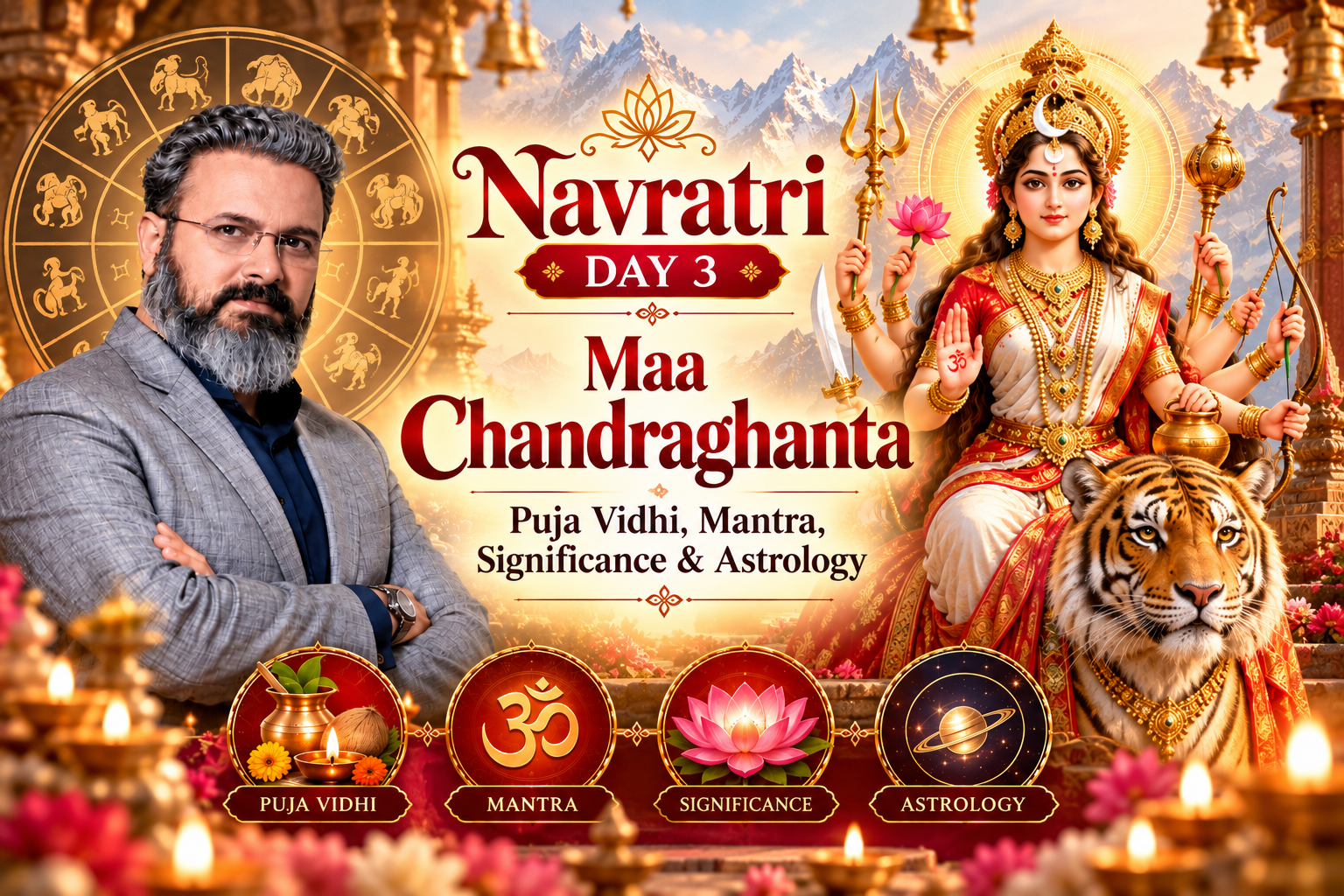
She is traditionally depicted riding a lion or tiger and possessing ten arms that carry various divine weapons and sacred objects.
A bell-shaped crescent moon adorns her forehead, givin g her the name Chandraghanta.
Her appearance represents the perfect balance between courage and com passion.
The lion symbolises fearlessness and determination, while her weapons represent divine protection and the destruction of negative forces.
Despite her fierce appearance, Maa Chandraghanta is considered compassionate toward her devotees.
The deeper Maa Chandraghanta Significance lies in understanding that true strength is not about aggression. It is about protecting what is right while maintaining inner peace.
The Divine Story of Maa Chandraghanta
According to traditional accounts associated with Goddess Parvati, Maa Chandraghanta’s story is connected with her marriage to Lord Shiva.
After Goddess Parvati completed her intense tapasya, Lord Shiva agreed to marry her.
However, when Lord Shiva arrived for the wedding procession, his unusual appearance and the presence of his attendants frightened members of Parvati’s family.
In popular devotional retellings, Goddess Parvati assumed her powerful Chandraghanta form and requested Lord Shiva to appear in a peaceful and beautiful form for the wedding.
The marriage then took place with joy and divine blessings.
This story represents an important spiritual lesson.
Strength and compassion can exist together. True courage does not mean creating fear but having the wisdom to restore peace.
This is one of the central teachings of Navratri Day 3 Maa Chandraghanta.
Why Is Maa Chandraghanta Worshipped on Navratri Day 3?
The spiritual journey of Navratri progresses through different stages of inner development.
On Day 1, Maa Shailputri represents stability and strong foundations.
On Day 2, Maa Brahmacharini represents devotion, patience and discipline.
On Day 3, Maa Chandraghanta represents courage and the ability to face challenges.
The Third Day of Navratri encourages devotees to move beyond fear and develop confidence in their actions.
Maa Chandraghanta teaches that spiritual growth requires both inner discipline and the courage to confront difficulties.
Her worship reminds us to remain peaceful without becoming weak and to remain strong without becoming aggressive.
Spiritual Meaning of Maa Chandraghanta
The spiritual significance of Maa Chandraghanta is deeply connected with courage, protection and emotional balance.
Her divine form communicates four important spiritual lessons.
Courage: Face difficult situations with determination rather than fear.
Inner Peace: Maintain emotional balance even when circum stances become challenging.
Protection: Stand against injustice and harmful influences.
Self-Control: Use personal strength wisely rather than acting impulsively.
These teachings make Navratri Day 3 Maa Chandraghanta meaningful for individuals dealing with uncertainty, emotional challenges or difficult decisions.
Her message is simple: genuine strength comes from a peaceful and fearless mind.
Maa Chandraghanta and the Manipura Chakra
In some yogic inter pretations of the Navadurga journey, Maa Chandraghanta is associated with the Manipura Chakra, also called the Solar Plexus Chakra.
The Manipura Chakra is traditionally linked with personal power, confidence, determination and the ability to take action.
This spiritual association complements the qualities represented by Maa Chandraghanta.
The first day of Navratri establishes stability, the second develops discipline, and the third encourages confident action.
The Maa Chandraghanta spiritual meaning reminds devotees that confidence becomes meaningful when it is guided by wisdom and self-control.
Maa Chandraghanta Puja Vidhi
Devotees can perform Maa Chandraghanta Puja on the third day of Navratri with sincerity and devotion.
A simple traditional worship sequence may include:
Wake up early, bathe and wear clean clothes.
Clean and prepare the puja area.
Place an image or r epre sentation of Maa Chandraghanta in the worship space.
Light a diya and incense.
Offer flowers, fruits and other traditional offerings according to family customs.
Recite the Chandraghanta Mantra with concentration.
Spend a few moments in meditation or silent prayer.
Perform aarti and pray for courage, peace and spiritual protection.
The exact Maa Chandraghanta Puja Vidhi for Navratri Day 3 may vary according to regional and family traditions.
Devotion, sincerity and peaceful intention remain the most important elements of worship.
Maa Chandraghanta Mantra
A commonly recited Chandraghanta Mantra is:
ॐ देवी चन्द्रघण्टायै नमः॥
Om Devi Chandraghantayai Namah ॥
Devotees chant this mantra during Navratri Day 3 Maa Chandraghanta worship to honour the Goddess and seek her blessings.
Another traditional prayer associated with Maa Chandraghanta is:
पिण्डजप्रवरारूढा चण्डकोपास्त्रकैर्युता।
प्रसादं तनुते मह्यं चन्द्रघण्टेति विश्रुता॥
This prayer praises Maa Chandraghanta’s powerful divine form and seeks her grace.
Mantra chanting can also serve as a medit ative practice that encourages concentration, calmness and spiritual awareness.
Maa Chandraghanta Mantra and Benefits
The spiritu al practice of chanting the Maa Chandraghanta Mantra is traditionally associated with developing qualities such as:
Courage and confidence
Emotional stability
Inner peace
Spiritual determination
Patience and self-control
Devotion and concentration
A sense of spiritual protection
Strength to face difficult circumstances
The Maa Chandraghanta Mantra Benefits are understood within devotional tradition rather than as guaranteed outcomes.
The deeper purpose of mantra practice is to strengthen faith, awareness and inner discipline.
Maa Chandraghanta and Astrology
The astrological significance of Maa Chandraghanta provides another perspective on the third day of Navratri.
In some Navadurga astrological traditions, Maa Chandraghanta is associated with Venus, also known as Shukra.
In Vedic astrology, Venus is traditionally associated with relations hips, beauty, harmony, comforts, creativity and the ability to appreciate balance in life.
At first, the warrior form of Maa Chandraghanta may seem different from the qualities represented by Venus.
However, their symbolic connection can be understood through the importance of harmony.
Maa Chandraghanta represents strength guided by peace, while Venus symbolises harmony and relationships.
From this perspective, Chandraghanta Astrology encourages individuals to develop courage without losing compassion.
Planetary associations with Navadurga can vary between traditions, and they should not be treated as universal astrological rules.
Maa Chandraghanta and Venus in Vedic Astrology
Venus, or Shukra, holds an important position in Vedic astrology.
It is traditionally associated with relationships, attraction, artistic expression, material comforts and harmony.
Its in terpretation depends on factors such as planetary placement, house ownership, aspects and the overall birth chart.
The connection between Maa Chandraghanta and Venus in Vedic Astrology can be understood symbolically through emotional balance and harmonious action.
During Navratri Day 3, devotees may reflect on questions such as:
Am I maintaining peace in my relationships?
Do I react with anger when facing disagreements?
Can I remain confident without becoming aggressive?
Am I balancing my personal desires with responsibility?
These questions help transform Navratri into a period of personal reflection and spiritual development.
For individual astrological concerns, the complete birth chart should be considered rather than relying on general planetary associations.
What Does Maa Chandraghanta Teach Us About Modern Life?
Modern life often brings uncertainty, com petition, emotional pressure and difficult decisions.
People may experience challenges in their careers , relationships, finances or personal lives.
Maa Chandraghanta teaches that fear should not control our decisions.
Her divine form encourages devotees to remain calm while developing the courage to face difficulties.
In professional life, this can mean making responsible decisions with confidence.
In relationships, it can mean communicating honestly while maintaining compassion.
In personal development, it can mean overcoming self-doubt and taking meaningful action.
The message of Navratri Day 3 Maa Chandra ghanta is especially relevant today because true confidence requires both courage and emotional maturity.
How to Follow Maa Chandraghanta’s Teachings During Navratri
The teachings of Maa Chandraghanta can be incorporated into daily life through simple spiritual practices.
During the Third Day of Navratri, consider focusing on the follow ingactions:
Begin your morning with prayer or meditation.
Identify one fear that is limiting y our personal growth.
Practise responding calmly during disagreements.
Make an important decision with patience and clarity.
Avoid unnecessary anger and negative communication.
Offer help to someone facing difficulties.
Reflect on the difference between confidence and aggression.
These practices reflect the deeper meaning of Maa Chandraghanta Puja—developing inner strength while maintaining peace and compassion.
Navratri Day 3: The Power of Courage and Inner Peace
Navratri Day 3 Maa Chandraghanta represents an important stage in the nine-day spiritual journey.
After developing stability through Maa Shailputri and discipline through Maa Brahmacharini, devotees are encouraged to cultivate courage through Maa Chandraghanta .
Her divine form reminds us that strength and peace are not opposing qualities.
A truly strong person can remain calm during difficult situations and act with confidence when necessary.
Through Maa Chandraghanta Puja, mantra chanting, meditation and self-reflection, devotees can use the third day of Navratri to strengthen their determination and spiritual awareness.
Frequently Asked Questions:
- Which Goddess is worshipped on Navratri Day 3?
Maa Chandraghanta is worshipped on the Third Day of Navratri. She is the third form of Navadurga and represents courage, peace, protection and spiritual strength.
2. What is the Maa Chandraghanta Mantra?
A commonly recited Chandraghanta Mantra is “Om Devi Chandraghantayai Namah.” Devotees chant it during Navratri Day 3 Maa Chandraghanta worship.
3. What is the significance of Maa Chandraghanta?
Maa Chandraghanta Significance is associated with courage, inner peace, fearlessness and protection. Her divine form teaches devotees to balance strength with compassion.
- Which planet is associated with Maa Chandraghanta?
In some Navadurga astrological traditions, Maa Chandraghanta is associated with Venus or Shukra. In Chandraghanta Astrology, this connection symbolically represents harmony ,
relationships and emotional balance.
5. What are the benefits of worshipping Maa Chandraghanta?
Maa Chandraghanta Puja and mantra chanting are traditionally associated with cultivating courage, confidence, emotional stability, inner peace and spiritual determination.
Conclusion
The third day of Navratri celebrates the divine qualities of courage, peace and spiritual protection.
Navratri Day 3 Maa Chandraghanta reminds us that genuine strength comes from a balanced mind and a compassionate heart.
Through Maa Chandraghanta Puja, the Chandraghanta Mantra, meditation and spiritual reflection, devotees can develop greater confidence, patience and inner awareness.
Her teachings encourage us to overcome fear, act responsibly and maintain peace even during challenging circumstances.
May Maa Chandraghanta bless devotees with courage, wisdom, protection and inner peace throughout the sacred journey of Navratri.
Guru Ji Dr Raj – Mystic Guru | Vedic Astrologer
For deeper insights into Vedic Astrology, spirituality, Navratri and traditional wisdom, explore more guidance from Guru Ji Dr Raj at raj.guru