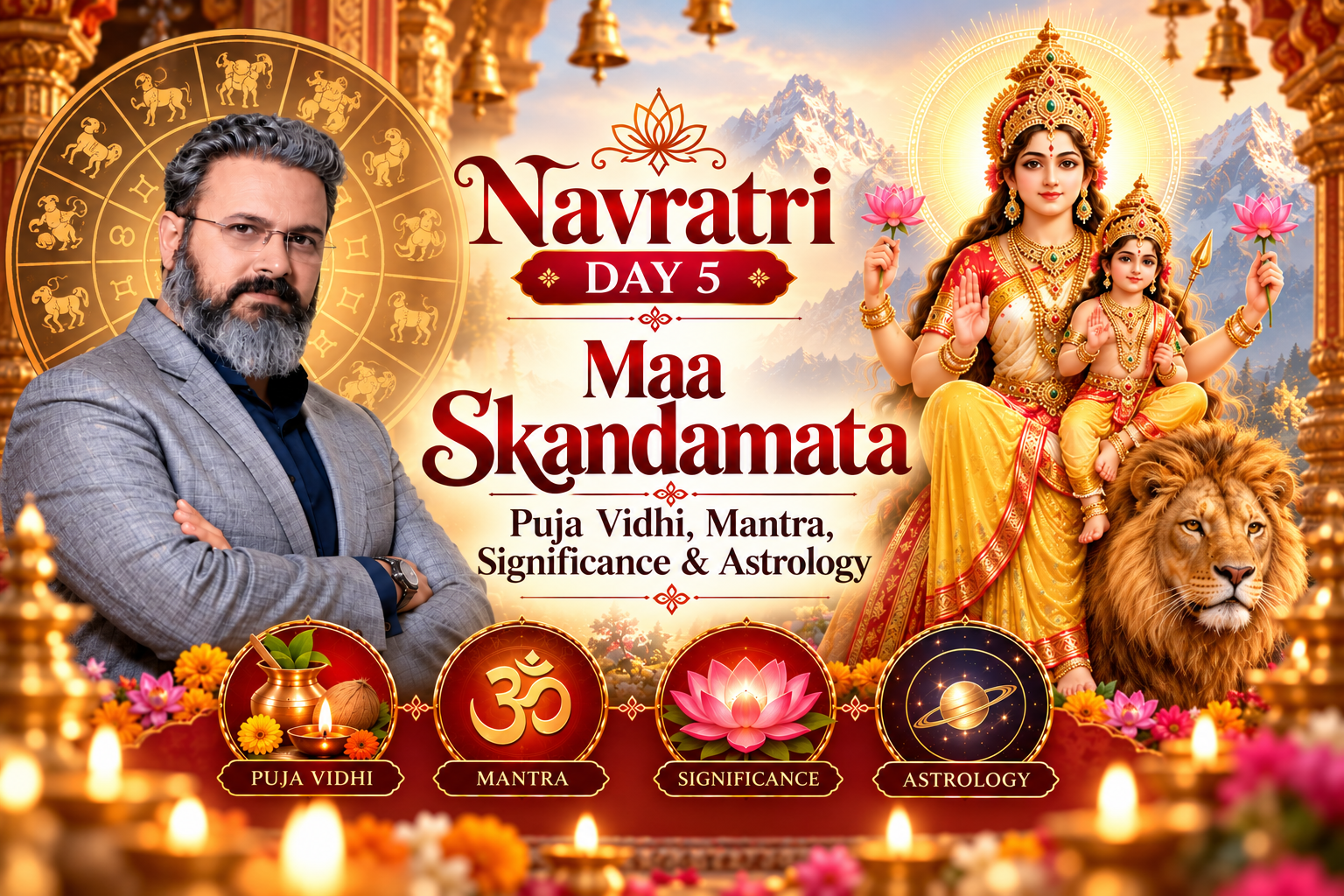
Navratri Day 5 Maa Skandamata: Puja Vidhi, Mantra, Benefits & Astrology Explained by Guru Ji Dr Raj
Nine Nights. Nine Goddesses. Nine Divine Secrets! Discover Navratri’s spiritual wisdom, karmic significance and astrological insights with Guru Ji Dr. Raj, PhD in Astrology, National Award winner and renowned Singapore astrologer. With 31+ years of experience, he presents an exclusive nine-day Navratri series on raj.guru, guiding devotees towards spiritual transformation.
Navratri Day 5 Maa Skandamata celebrates the fifth divine form of Goddess Durga. After worshi pping Maa Shailputri, Maa Brahmacharini, Maa Chandraghanta and Maa Kushmanda, devotees honour Maa Skandamata on the Fifth Day of Navratri.
Maa Skandamata represents motherhood, unconditional love, compassion, wisdom and divine protection. She is revered as the mother of Lord Skanda, also known as Kartikeya or Murugan, the divine warrior and son of Lord Shiva and Goddess Parvati.
The name Skandamata comes from two words: “Skanda,” referring to Lord Kartikeya, and “Mata,” meaning mother. Her divine form represents the nurturing power of motherhood combined with courage and spiritual strength.
During Navratri Day 5, devotees seek her blessings for wisdom, family harmony, inner peace and spiritual development.
In this guide, we explore Maa Skandamata Puja, Skandamata Mantra, Maa Skandamata Significance, her divine story, spiritual teachings and the astrological significance of Maa Skandamata.
Who Is Maa Skandamata?
Maa Skandamata is the fifth manifestation among the Nine Forms of Maa Durga, collectively known as Navadurga.
She is traditionally depicted with four arms, seated on a lion and holding her son, Lord Skanda, in her lap.
In her other hands, she carries lotus flowers, while one hand is often shown in a blessing gesture.
Maa Skandamata is also associated with the lotus and is sometimes called Padmasana Devi because of her connection with the lotus seat.
Her divine app earance represents a beautiful balance between motherly affection and powerful protection.
The lion symbolises courage and strength, while the lotus represents purity, wisdom and spiritual growth.
The deeper Maa Skandamata Significance lies in understanding that genuine strength includes the ability to nurture, protect and guide others with compassion.
The Divine Story of Maa Skandamata
According to Hindu tradition, Lord Skanda, also known as Kartikeya, was born to Lord Shiva and Goddess Parvati.
He is revered as a divine warrior who led the forces of the Devas against powerful adversaries.
In traditional accounts, Lord Kartikeya is associated with the defeat of the demon Tarakasur a, who had become a threat to the Devas.
Goddess Parvati, as the mother of Lord Skanda, is worshipped in her divine form as Maa Skandamata.
Her appearance holding the young Kartike ya represents the sacred relationship between a mother and child.
However, the story carries a deeper spiritual message.
The mother of a powerful warrior is herself a symbol of strength, wisdom and protection.
Maa Skandamata reminds devotees that compassion and courage are not opposing qualities. They are two expressions of divine power.
This is one of the central teachings of Navratri Day 5 Maa Skandamata.
Why Is Maa Skandamata Worshipped on Navratri Day 5?
The spiritual journey of Navratri progresses through nine divine forms of Goddess Durga.
Each form represents qualities that devotees can cultivate in everyday life.
On Day 1, Maa Shailputri represents stability and strong foundations.
On Day 2, Maa Brahmacharini represents devotion and discipline.
On Day 3, Maa Chandraghanta represents courage and inner peace.
On Day 4, Maa Kushmanda represents creativity, vitality and positive transformation.
On Day 5, Maa Skandamata represents unconditional love, compassion, wisdom and nurturing strength.
The Fifth Day of Navra tri encourages devotees to recognise the importance of family relationships, emotional understanding and selfless service.
Maa Skandamata teaches that spiritual growth becomes more meaningful when knowledge and strength are guided by compassion.
Spiritua l Meaning of Maa Skandamata
The spiritual significance of Maa Skandamata is closely associated with motherhood, protection, wisdom and unconditional love.
Her divine form teaches four important spiritual lessons.
Compassion: Treat others with kindness and understanding.
Protection: Support and protect those who depend on you.
Wisdom: Use knowledge responsibly to guide your actions.
Selfless Love: Recognise the value of giving without constantly expecting some thing in return.
These teachings make Navratri Day 5 Maa Skandamata meaningful for individuals seeking emotional balance, stronger relationships, and spiritual growth.
Her divine appearance reminds devotees that true power is not measured only by achievements but also by the ability to care for others.
Maa Skandamata and the Vishuddha Chakra
In some interpretations of the Navadurga spiritual journey, Maa Skandamata is associated with the Vishuddha Chakra, also known as the Throat Chakra.
The Vishuddha Chakra is traditionally linked with communication, truthfulness, self-expression and clarity.
This spiritual association complements the qualities represented by Maa Skandamata.
A nurturing relationship requires not only love but also honest communication, patience and understanding.
During Navratri Day 5, devotees may reflect on how their words influence family members, friends and colleagues.
The deeper lesson is that compassionate communication can strengthen relationships and encourage emotional harmony.
Maa Skandamata Puja Vidhi
Devotees can perform Maa Skandamata Puja on the fifth day of Navratri with sincerity and devotion.
A simple traditional worship sequence may include:
Wake up early, bathe and wear clean clothes.
Clean and prepare the puja area.
Place an image or representation of Maa Skandamat a in the worship space.
Light a diya and incense.
Offer flowers, fruits and other traditional offerings according to family customs.
Bananas are offered to Maa Skandamata in some devotional traditions.
Recite the Skandamata Mantra with concentration.
Perform aarti and pray for wisdom, compassion, family harmony and spiritual growth.
The exact Maa Skandamata Puja Vidhi for Navratri Day 5 may vary according to regional and family customs.
Devotion, sincerity and peaceful intention remain central to worship.
Maa Skandamata Mantra
A commonly recited Skandamata Mantra is:
ॐ देवी स्कन्दमातायै नमः॥
Om Devi Skandamatayai Namah ॥
Devotees chant this mantra during Navratri Day 5 Maa Skandamata worship to honour the Goddess and seek her blessings.
Another traditional prayer associated with Maa Skandamata is:
सिंहासनगता नित्यं पद्माश्रितकरद्वया।
शुभदास्तु सदा देवी स्कन्दमाता यशस्विनी॥
This prayer praises Maa Skandamata’s divine form and seeks her auspicious blessings.
Mantra chanting can also serve as a meditative practice that encourages concentration, calmness, and spiritual awareness.
Maa Skandamata Mantra and Benefits
The spiritual practice of chanting the Maa Skandamata Mantra is traditionally associated with cultivating qualities such as:
Compassion and kindness
Inner peace
Patience and understanding
Spiritual wisdom
Devotion and concentration
Family harmony
Emotional balance
Selfless love and responsibility
The Maa Skandamata Mantra Benefi ts are understood within devotional tradition rather than as guaranteed physical, financial or personal outcomes.
The deeper purpose of mantra practice is to strengthen faith, awareness and spiritual discipline.
Maa Skandamata and Astrology
Th e astrological s ignificance of Maa Skandamata provides another perspective on the fifth day of Navratri.
In some Navadurga astrological traditions, Maa Skandamata is associated with Mercury, also known as Budh.
In Vedic astrology, Mercury is traditionally connected with intelligence, communication, learning, an alytical thinking and adaptability.
This association can be understood through Maa Skandamata’s qualities of wisdom, guidance, and nurturing intelligence.
Just as a mother guides a child through knowledge and understanding, Mercury symbolically represents the ability to learn, communicate and make thoughtful decisions.
From this perspective, Skandamata Astrology encourage s individuals to develop wisdom, clear communication and responsible thinking.
However, planetary as sociations with Navadurga may vary across traditions and should not be treated as universal astrological rules.
Maa Skandamata and Mercury in Vedic Astrology
Mercury, or Budh, holds an important position in Vedic Astrology.
It is traditionally associated with communication, intellect, education, business, reasoning and adaptability.
Its interpretation in an individual’s birth chart depends on planetary placement, house ownership, aspects and other astrological factors.
The symbolic connection between Maa Skandamata and Mercury in Vedic Astrology high lights the importance of thoughtful communication and wisdom.
During Navratri Day 5, devotees may reflect on questions such as:
Am I communicating with kindness and understanding?
Do I listen carefully before making judgments?
Am I using my knowledge to support others ?
Do I balance logic with compassion?
These questions help transform Navratri into a period of spiritual reflection and personal development.
For individual astro logical concerns, the complete birth chart should be considered rather than relying on general planetary associations.
What Does Maa Skandamata Teach Us A bout Modern Life?
Modern life often places significant demands on individuals and families.
People balance careers, relationships, financial responsibilities and personal ambitions.
During this process, emotional connections and meaningful communication can sometimes receive less attention.
Maa Skandamata teaches that genuine success includes the ability to nurture and support others.
In family life, this can mean spending meaningful time with loved ones and offering emotional support.
In professional life, it can mean guiding colleagues with patience and understanding.
In personal development, it can mean recognising that compassion and wisdom are equally important.
The message of Navratri Day 5 Maa Skandamata is especially relevant today because healthy relationships require patience, kindness and responsible communication.
How to Follow Maa Skandamata’s Teachings During Navratri
The teachings of Maa Skandamata can be incorporated into every day life through simple spiritual practices.
During the Fifth Day of Navratri, consider focusing on the following actions:
Begin your morning with gratitude and prayer.
Spend meaningful time with family members.
Practise patient and compassionate communication.
Offer support to someone facing difficulties.
Avoid unnecessary arguments and harsh words.
Reflect on the importance of selfless service.
Develop patience while guiding or teaching others.
Express appreciation toward people who support you.
These practices reflect the deeper meaning of Maa Skandamata Puja—cultivating compassion, wisdom and spiritual awareness.
Navratri Day 5: The Power of Motherhood and Divine Compassion
Navratri Day 5 Maa Skandamata represents an important stage in the nine-day spiritual journey.
After developing stability through Maa Shailputri, discipline through Maa Brahmacharini, courage through Maa Chandraghanta and positive transformation through Maa Kushmanda, devotees are encouraged to cultivate compassion and wisdom through Maa Skandamata.
Her divine form reminds us that strength becomes more meaningful when guided by kindness.
Through Maa Skandamata Puja, mantra chanting, meditation and self-reflection, devotees can use the fifth day of Navratri to strengthen their emotional awareness, relationships and spiritual understanding.
Frequently Asked Questions
1. Which Goddess is worshipped on Navratri Day 5?
Maa Skandamata is worshipped on the Fifth Day of Navratri. She is the fifth form of Navadurga and represents motherhood, compassion, wisdom and divine protection.
- What is the Maa Skandamata Mantra?
A commonly recited Skandamata Mantra is “Om Devi Skandamatayai Namah.” Devotees chantit during Navratri Day 5 Maa Skandamata worship.
- What is the significance of Maa Skandamata?
Maa Skandamata Significance is associated with motherhood, unconditional love, compassion, wisdom and spiritual protection. She is depicted holding her son, Lord Skanda or Kartikeya.
- Which planet is associated with Maa Skandamata?
In some Navadurga a strological traditions, Maa Skandamata is associated with Mercury or Budh. In Skandamat a Astrology, this connection symbolically represents intelligence, communication, learning and wisdom.
5. What are the benefits of worshipping Maa Skandamata?
Maa Skandamata Puja and mantra chanting are traditionally associated with cultivating compassion, patience, emotional balance, wisdom and spiritual awareness.
Conclusion
The fifth day of Navratri celebrates the divine qualities of motherhood, compassion and spiritual wisdom.
Navratri Day 5 Maa Skandamata reminds us that genuine strength is expressed through kindness, understanding and the willingness to support others.
Through Maa Skandamata Puja, the Skandamata Mantra, meditation and spiritual reflection, devotees can develop greater patience, emotional balance and inner awareness.
Her teachings encourage us to strengthen family relationships, communicate compassionately, and use our knowledge responsibly.
May Maa Skandamata bless devotees with wisdom, harmony, compassion, and spiritual growth throughout the sacred journey of Navratri.
Guru Ji Dr Raj – Mystic Guru | Vedic Astrologer
For deeper insights into Vedic Astrology, spirituality, Navratri, and traditional wisdom, explore more guidance from Guru Ji Dr Raj at raj.guru