Navratri Day 8 Maa Mahagauri: Ashtami Puja Vidhi, Mantra, Benefits & Astrology Explained by Guru Ji Dr Raj
Nine Nights. Nine Goddesses. Nine Divine Secrets! Discover Navratri’s spiritual wisdom, karmic significance and astrological insights with Guru Ji Dr. Raj, PhD in Astrology, National Award winner and renowned Singapore astrologer. With 31+ years of experience, he presents an exclusive nine-day Navratri series on raj.guru, guiding devotees towards spiritual transformation.
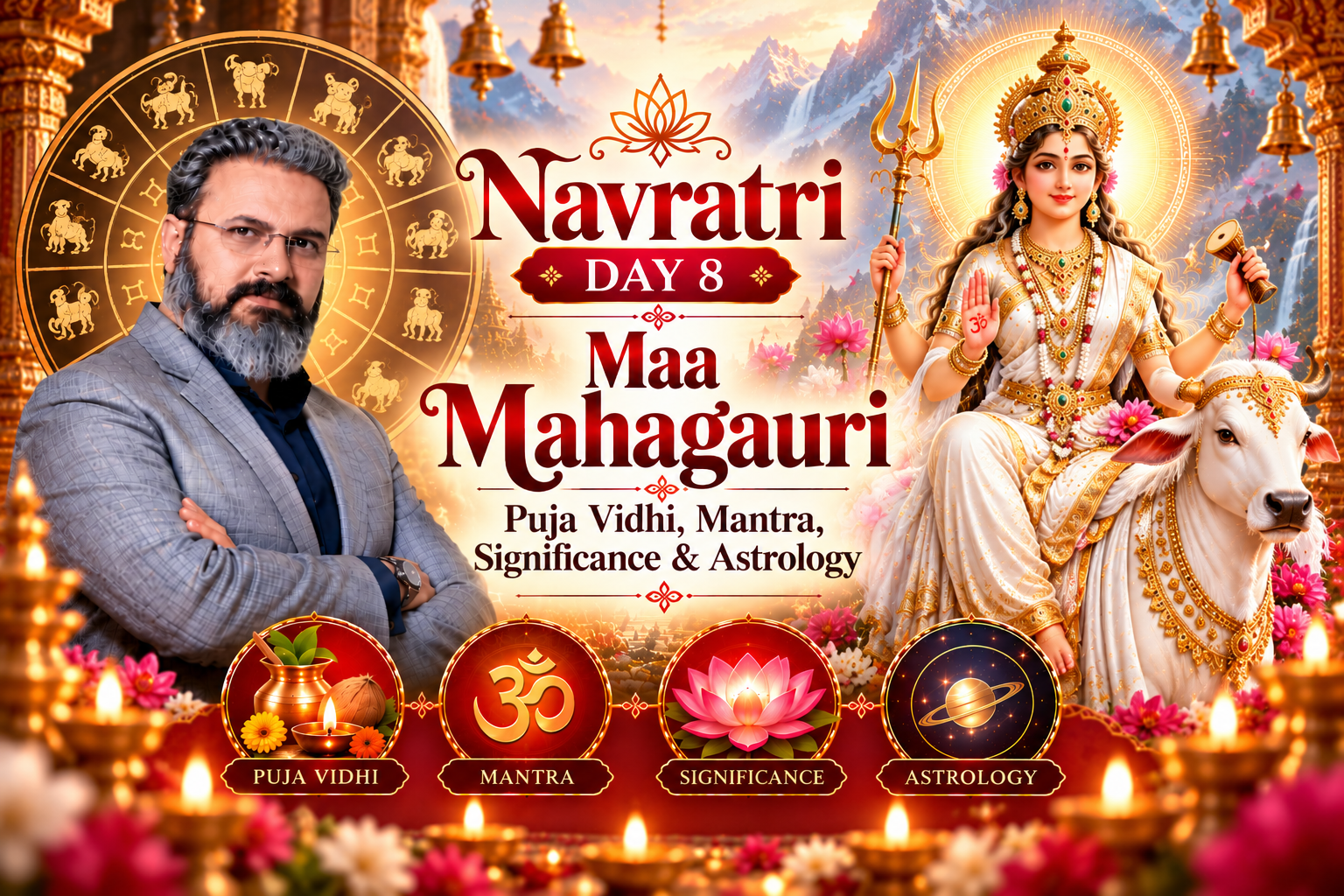
Navratri Day 8 Maa Mahagauri celebrates the eighth divine form of Goddess Durga. After worshipping Maa Kalaratri on the seventh day, devotees honour Maa Mahagauri on the Eighth Day of Navratri, traditionally associated with Durga Ashtami or Maha Ashtami.
Maa Mahagauri represents purity, peace, compassion, spiritual transformation and new beginnings. Her radiant white appearance symbolises inner clarity and the removal of ignorance.
The name Mahagauri comes from two Sanskrit words: “Maha,” meaning great, and “Gauri,” meaning fair or radiant. Her divine form represents purity of intention, devotion and spiritual wisdom.
During Navratri Day 8, devotees seek her blessings for peace, harmony, wisdom and spiritual growth.
In this guide, we explore Maa Mahagauri Puja, Mahagauri Mantra, Maa Mahagauri Significance, her divine story, Navratri Ashtami Puja, Kanya Pujan and the astrological significance of Maa Mahagauri.
Who Is Maa Mahagauri?
Maa Mahagauri is the eighth manifestation among the Nine Forms of Maa Durga, collectively known as Navadurga.
She is traditionally depicted with four arms, wearing white garments and riding a bull.
In her hands, she carries a trident and a damaru, while her other hands are shown in gestures of blessing and protection.
Her peaceful appearance represents compassion, purity and spiritual awareness.
The bull symbolises stability, patience and determination, while her white garments represent purity and inner peace.
The deeper Maa Mahagauri Significance lies in understanding that spiritual transformation requires patience, self-discipline and the willingness to move beyond negativity.
Her divine form reminds devotees that true purity begins with thoughts, intentions and actions.
The Divine Story of Maa Mahagauri
According to popular Hindu devotional traditions, Maa Mahagauri’s story is connected with Goddess Parvati’s intense penance to obtain Lord Shiva as her husband.
Goddess Parvati performed severe tapasya for a long period with unwavering devotion and determination.
During this penance, her body became covered with dust and her complexion darkened.
Pleased with her devotion, Lord Shiva accepted her as his consort.
In popular retellings, Lord Shiva bathed Goddess Parvati with the sacred waters of the Ganga, restoring her radiant appearance.
Because of her luminous form, she became known as Mahagauri.
This traditional story symbolises purification, spiritual renewal and the transformation that follows sincere effort.
The deeper meaning of Navratri Day 8 Maa Mahagauri is that spiritual growth is possible through patience, devotion and the willingness to change.
Why Is Maa Mahagauri Worshipped on Navratri Day 8?
The spiritual journey of Navratri progresses through nine divine forms of Goddess Durga.
Each form represents qualities that devotees can cultivate within themselves.
Day 1 represents stability through Maa Shailputri.
Day 2 represents devotion and discipline through Maa Brahmacharini.
Day 3 represents courage and peace through Maa Chandraghanta.
Day 4 represents creativity and positive energy through Maa Kushmanda.
Day 5 represents compassion and wisdom through Maa Skandamata.
Day 6 represents righteousness and determination through Maa Katyayani.
Day 7 represents fearlessness and transformation through Maa Kalaratri.
Day 8 represents purity, peace and spiritual renewal through Maa Mahagauri.
The Eighth Day of Navratri encourages devotees to reflect on their actions, release negative habits and develop a more peaceful approach to life.
Maa Mahagauri teaches that true transformation begins with self-awareness and sincere intention.
Spiritual Meaning of Maa Mahagauri
The spiritual significance of Maa Mahagauri is closely associated with purity, compassion, forgiveness and inner peace.
Her divine form teaches four important spiritual lessons.
Purity: Develop honesty and sincerity in thoughts, words and actions.
Forgiveness: Release unnecessary resentment and emotional burdens.
Transformation: Recognise that personal growth requires patience and effort.
Inner Peace: Maintain emotional balance through awareness and self-discipline.
These teachings make Navratri Day 8 Maa Mahagauri meaningful for individuals seeking clarity, emotional harmony and spiritual growth.
Her radiant appearance reminds devotees that genuine transformation comes from within.
Maa Mahagauri and Spiritual Transformation
The journey from Maa Kalaratri on Day 7 to Maa Mahagauri on Day 8 carries an important symbolic meaning.
Maa Kalaratri represents the courage to confront fear, ignorance and destructive influences.
Maa Mahagauri represents the peace and clarity that can follow this process of inner transformation.
This progression suggests that spiritual growth involves both confronting difficulties and cultivating positive qualities.
During Navratri Day 8, devotees may reflect on their behaviour, relationships and personal responsibilities.
The deeper lesson is that purification does not simply mean following external rituals. It also involves developing compassion, honesty and responsible conduct.
Maa Mahagauri Puja Vidhi
Devotees can perform Maa Mahagauri Puja on the eighth day of Navratri with sincerity and devotion.
A simple traditional worship sequence may include:
Wake up early, bathe and wear clean clothes.
Clean and prepare the worship area.
Place an image or representation of Maa Mahagauri in the puja space.
Light a diya and incense.
Offer flowers, fruits and other traditional offerings according to family customs.
Coconut and sweets are offered in some devotional traditions.
Recite the Mahagauri Mantra with concentration.
Perform aarti and pray for peace, wisdom and spiritual growth.
The exact Maa Mahagauri Puja Vidhi for Navratri Day 8 may vary according to regional and family customs.
Devotion, sincerity and peaceful intention remain central to worship.
Maa Mahagauri Mantra
A commonly recited Mahagauri Mantra is:
ॐ देवी महागौर्यै नमः॥
Om Devi Mahagauryai Namah॥
Devotees chant this mantra during Navratri Day 8 Maa Mahagauri worship to honour the Goddess and seek her blessings.
Another traditional prayer associated with Maa Mahagauri is:
श्वेते वृषे समारूढा श्वेताम्बरधरा शुचिः।
महागौरी शुभं दद्यान्महादेवप्रमोददा॥
This prayer praises Maa Mahagauri’s radiant form and seeks her auspicious blessings.
Mantra chanting is traditionally practised as an expression of devotion and may also encourage concentration, calmness and spiritual reflection.
Maa Mahagauri Mantra and Benefits
The spiritual practice of chanting the Maa Mahagauri Mantra is traditionally associated with cultivating qualities such as:
Inner peace and emotional balance
Patience and self-discipline
Compassion and kindness
Spiritual awareness
Devotion and concentration
Forgiveness and understanding
Clarity of thought
Hope and positive transformation
The Maa Mahagauri Mantra Benefits are understood within devotional traditions rather than as guaranteed physical, financial or personal outcomes.
The deeper purpose of mantra practice is to strengthen faith, awareness and spiritual discipline.
Navratri Ashtami Puja and Kanya Pujan
One of the important traditions associated with Navratri Ashtami Puja is Kanya Pujan, also known as Kanjak Puja or Kumari Puja.
In this tradition, young girls are respectfully honoured as symbolic representations of the Divine Feminine.
Some families perform Kanya Pujan on Ashtami, while others observe it on Navami.
Traditionally, devotees invite young girls, offer them food and gifts, and seek their blessings.
Common offerings include puri, kala chana and halwa, although customs vary by region.
Kanya Pujan represents respect for feminine divinity, compassion and the importance of honouring others with dignity.
The spiritual meaning of Maa Mahagauri Ashtami Puja extends beyond ritual worship.
It reminds devotees that reverence for the Goddess should also be reflected in everyday respect, kindness and responsible behaviour.
Participation should always be respectful and voluntary, with appropriate attention to the children’s comfort and wellbeing.
Maa Mahagauri and Astrology
The astrological significance of Maa Mahagauri provides another perspective on the eighth day of Navratri.
In some Navadurga astrological traditions, Maa Mahagauri is associated with Rahu, one of the lunar nodes in Vedic astrology.
Rahu is traditionally connected with worldly desires, ambition, unconventional experiences, uncertainty and attachment.
This symbolic association can be understood through Maa Mahagauri’s qualities of purification, clarity and spiritual transformation.
While Rahu represents intense desires and unfamiliar experiences in some astrological interpretations, Maa Mahagauri symbolically represents the importance of developing clarity and inner balance.
From this perspective, Mahagauri Astrology encourages individuals to recognise unhealthy attachments and make thoughtful decisions.
However, planetary associations with Navadurga vary across traditions and should not be treated as universal astrological rules.
Maa Mahagauri and Rahu in Vedic Astrology
Rahu holds a distinctive position in Vedic Astrology.
Unlike the visible planets, Rahu is a mathematical lunar node associated with the intersection of the Moon’s orbital path and the apparent path of the Sun.
In traditional Jyotish, Rahu is symbolically associated with ambition, material desires, unconventional thinking, illusion and sudden developments.
Its interpretation in an individual’s birth chart depends on its placement, planetary associations, house position and relevant astrological periods.
The symbolic connection between Maa Mahagauri and Rahu in Vedic Astrology highlights the importance of awareness, self-control and clarity.
During Navratri Day 8, devotees may reflect on questions such as:
Am I allowing unnecessary desires to influence my decisions?
Do I remain calm when facing uncertainty?
Am I making choices based on awareness or temporary emotions?
Can I release habits that no longer support my personal growth?
These questions can help transform Navratri into an opportunity for spiritual reflection and personal development.
For individual astrological concerns, the complete birth chart should be considered rather than relying on general planetary associations.
Maa Mahagauri and the Importance of Inner Purification
Many devotees associate Maa Mahagauri Puja with spiritual purification and the removal of negative influences.
Within Hindu devotional traditions, the Goddess represents purity, compassion and the possibility of renewal.
The deeper meaning of purification can also be understood through everyday actions.
It may involve letting go of harmful habits, avoiding unnecessary conflict, practising forgiveness and developing greater self-awareness.
Maa Mahagauri’s teachings encourage devotees to recognise that spiritual progress is not limited to rituals.
It also involves how we treat others, respond to difficulties and take responsibility for our actions.
What Does Maa Mahagauri Teach Us About Modern Life?
Modern life often involves stress, emotional pressure, competition and difficult personal decisions.
People may carry resentment, self-doubt or unresolved disagreements that affect their relationships and wellbeing.
Maa Mahagauri teaches the importance of clarity, forgiveness and emotional maturity.
In professional life, this can mean learning from mistakes without remaining trapped in regret.
In relationships, it can mean communicating respectfully and practising forgiveness where appropriate.
In personal development, it can mean recognising unhealthy patterns and choosing more constructive habits.
The message of Navratri Day 8 Maa Mahagauri is especially relevant today because meaningful transformation begins with awareness and responsible action.
How to Follow Maa Mahagauri’s Teachings During Navratri
The teachings of Maa Mahagauri can be incorporated into everyday life through simple spiritual practices.
During the Eighth Day of Navratri, consider focusing on the following actions:
Begin your morning with prayer or meditation.
Reflect on one habit you would like to improve.
Practise patience during disagreements.
Express gratitude toward people who support you.
Release unnecessary resentment where possible.
Offer kindness and assistance to someone in need.
Avoid harsh communication and impulsive decisions.
Dedicate time to spiritual reflection and self-improvement.
These practices reflect the deeper meaning of Maa Mahagauri Puja—cultivating purity of intention, compassion and inner peace.
Navratri Day 8: The Power of Purity and Spiritual Renewal
Navratri Day 8 Maa Mahagauri represents an important stage in the nine-day spiritual journey.
After developing stability, discipline, courage, positive energy, compassion, righteousness and fearlessness through the first seven forms of Navadurga, devotees are encouraged to cultivate purity and spiritual renewal through Maa Mahagauri.
Her divine form reminds us that personal transformation becomes meaningful when reflected in our thoughts, words and actions.
Through Maa Mahagauri Puja, mantra chanting, meditation and self-reflection, devotees can use the eighth day of Navratri to strengthen their patience, emotional awareness and spiritual understanding.
Frequently Asked Questions
1. Which Goddess is worshipped on Navratri Day 8?
On Navratri Day 8 Maa Mahagauri is worshipped, traditionally associated with Durga Ashtami. She is the eighth form of Navadurga and represents purity, peace, compassion and spiritual transformation.
2. What is the Maa Mahagauri Mantra?
A commonly recited Mahagauri Mantra is “Om Devi Mahagauryai Namah.” Devotees chant it during Navratri Day 8 Maa Mahagauri worship.
3. What is the significance of Maa Mahagauri?
Maa Mahagauri Significance is associated with purity, forgiveness, inner peace and spiritual renewal. Her radiant white appearance symbolises clarity and transformation.
4. Which planet is associated with Maa Mahagauri?
In some Navadurga astrological traditions, Maa Mahagauri is associated with Rahu. In Mahagauri Astrology, this connection symbolically represents the importance of clarity, self-awareness and overcoming unhealthy attachments.
5. Is Kanya Pujan performed on Navratri Day 8?
Yes. Kanya Pujan is performed on Ashtami in many Hindu traditions. However, some families observe it on Navami. The practice honours young girls as symbolic representations of the Divine Feminine.
Conclusion
The eighth day of Navratri celebrates the divine qualities of purity, compassion, forgiveness and spiritual transformation.
Navratri Day 8 Maa Mahagauri reminds us that genuine transformation begins with sincere intentions, responsible actions and a peaceful mind.
Through Maa Mahagauri Puja, the Mahagauri Mantra, Navratri Ashtami Puja, meditation and spiritual reflection, devotees can cultivate greater clarity, patience and inner awareness.
Her teachings encourage us to release negativity, practise compassion and move toward spiritual growth.
May Maa Mahagauri bless devotees with wisdom, harmony, peace and spiritual strength throughout the sacred journey of Navratri.
Guru Ji Dr Raj – Mystic Guru | Vedic Astrologer
For deeper insights into Vedic Astrology, spirituality, Navratri and traditional wisdom, explore more guidance from Guru Ji Dr Raj at raj.guru