
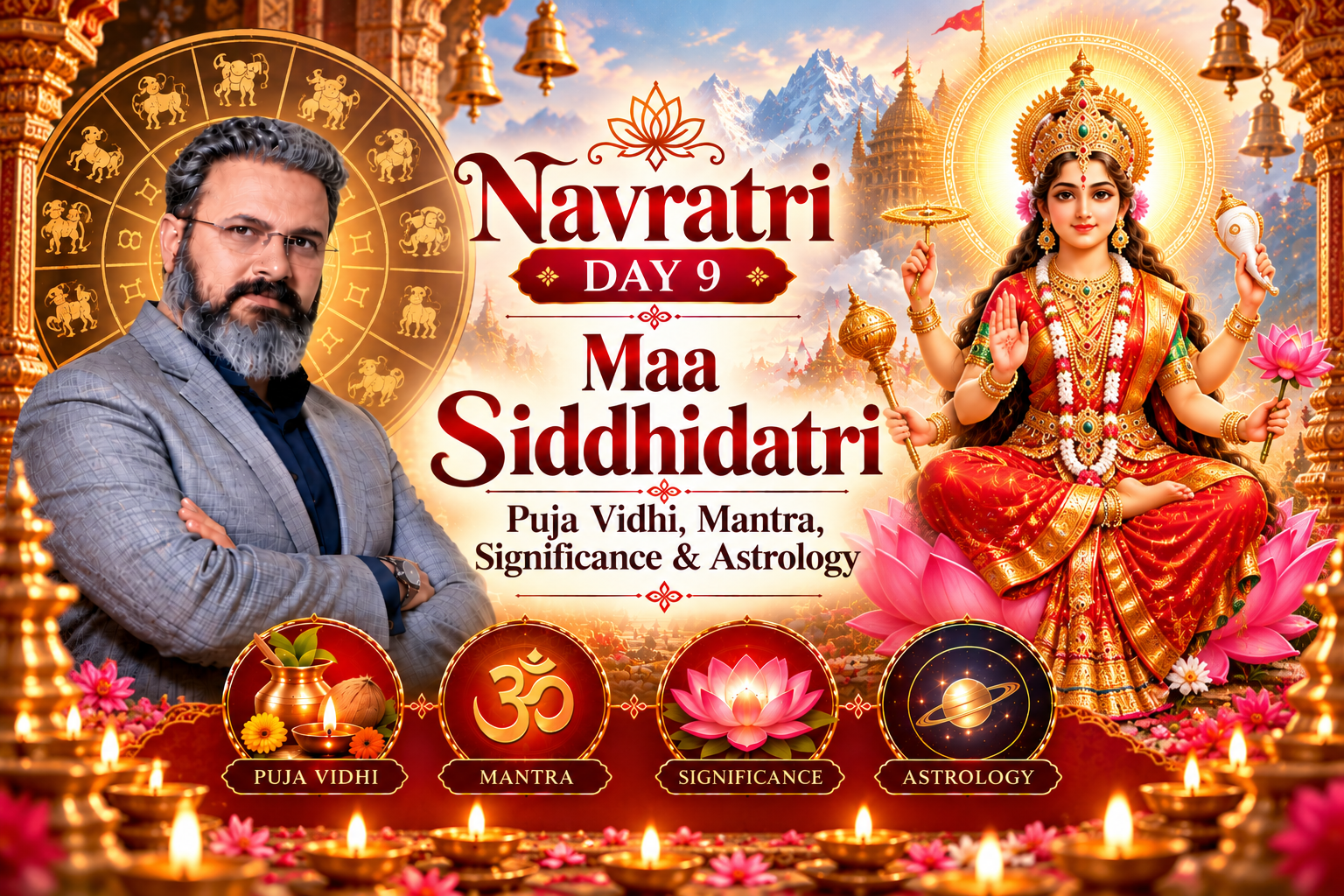
Navratri Day 9 Maa Siddhidatri: Navami Puja Vidhi, Mantra, Benefits & Astrology Explained by Guru Ji Dr Raj
Nine Nights. Nine Goddesses. Nine Divine Secrets! Discover Navratri’s spiritual wisdom, karmic significance and astrological insights with Guru Ji Dr. Raj, PhD in Astrology, National Award winner and renowned Singapore astrologer. With 31+ years of experience, he presents an exclusive nine-day Navratri series on raj.guru, guiding devotees towards spiritual transformation.
Navratri Day 9 Maa Siddhidatri celebrates the ninth and final divine form of Goddess Durga. After worshipping Maa Mahagauri on the eighth day, devotees honour Maa Siddhidatri on the Ninth Day of Navratri, traditionally associated with Maha Navami.
Maa Siddhidatri represents spiritual wisdom, divine knowledge, perfection and the fulfilment of spiritual aspirations. She is revered as the Goddess who bestows siddhis, traditionally understood as extraordinary spiritual attainments or powers.
The name Siddhidatri comes from two Sanskrit words: “Siddhi,” meaning accomplishment or spiritual attainment, and “Datri,” meaning giver. Her divine form represents the highest stage of spiritual awareness and the completion of the Navadurga journey.
During Navratri Day 9, devotees seek her blessings for wisdom, spiritual growth, inner peace and clarity.
In this guide, we explore Maa Siddhidatri Puja, Siddhidatri Mantra, Maa Siddhidatri Significance, her divine story, Navratri Navami Puja, Kanya Pujan and the astrological significance of Maa Siddhidatri.
Who Is Maa Siddhidatri?
Maa Siddhidatri is the ninth manifestation among the Nine Forms of Maa Durga, collectively known as Navadurga.
She is traditionally depicted with four arms, seated on a lotus or sometimes shown riding a lion.
In her four hands, she carries a discus, conch, mace and lotus.
The discus symbolises divine order and protection, while the conch represents sacred sound and spiritual awakening.
The mace represents strength and authority, and the lotus symbolises purity, wisdom and spiritual development.
Her peaceful appearance reflects the highest qualities of divine consciousness.
The deeper Maa Siddhidatri Significance lies in understanding that spiritual accomplishment is not merely about obtaining extraordinary powers. It is also about developing wisdom, humility, self-awareness and inner peace.
The Divine Story of Maa Siddhidatri
According to Hindu devotional traditions, Maa Siddhidatri is revered as the divine source of spiritual attainments.
Popular Navadurga narratives describe a time when Lord Shiva worshipped the Supreme Goddess to receive spiritual perfection.
Pleased with his devotion, Maa Siddhidatri bestowed divine siddhis upon him.
In some traditional interpretations, this divine blessing is connected with the manifestation of Ardhanarishvara, the combined form of Lord Shiva and Goddess Shakti.
Ardhanarishvara represents the inseparable relationship between consciousness and divine energy.
One half symbolises Shiva, while the other represents Shakti.
This sacred form communicates the importance of balance, unity and the complementary nature of divine principles.
The story of Navratri Day 9 Maa Siddhidatri teaches that spiritual fulfilment is associated with wisdom, humility and the recognition of divine unity.
Why Is Navratri Day 9 Maa Siddhidatri Worshipped for Divine Blessings and Spiritual Powers?
The spiritual journey of Navratri progresses through nine divine forms of Goddess Durga.
Each form represents a different stage of inner development.
Day 1 represents stability through Maa Shailputri.
Day 2 represents devotion and discipline through Maa Brahmacharini.
Day 3 represents courage and peace through Maa Chandraghanta.
Day 4 represents creativity and positive energy through Maa Kushmanda.
Day 5 represents compassion and wisdom through Maa Skandamata.
Day 6 represents righteousness and determination through Maa Katyayani.
Day 7 represents fearlessness and transformation through Maa Kalaratri.
Day 8 represents purity and spiritual renewal through Maa Mahagauri.
Day 9 represents spiritual wisdom, fulfilment and divine consciousness through Maa Siddhidatri.
The Ninth Day of Navratri marks the completion of this symbolic spiritual journey.
Maa Siddhidatri reminds devotees that genuine spiritual accomplishment involves wisdom, compassion, discipline and self-awareness.
Spiritual Meaning of Maa Siddhidatri
The spiritual significance of Maa Siddhidatri is closely associated with wisdom, fulfilment, divine knowledge and spiritual liberation.
Her divine form teaches four important spiritual lessons.
Wisdom: Develop a deeper understanding of life through knowledge and reflection.
Humility: Recognise that genuine accomplishment should not create arrogance.
Spiritual Awareness: Cultivate inner clarity and a meaningful connection with spiritual values.
Fulfilment: Understand that lasting satisfaction comes from purpose, gratitude and responsible action.
These teachings make Navratri Day 9 Maa Siddhidatri meaningful for individuals seeking spiritual growth, personal clarity and inner peace.
Her divine form reminds devotees that the highest achievement is not simply external success but the development of wisdom and self-understanding.
What Are the Eight Siddhis Associated with Maa Siddhidatri?
Maa Siddhidatri is traditionally associated with the granting of eight major siddhis, known as Ashta Siddhis.
These are described in various Hindu yogic and devotional traditions as extraordinary spiritual powers.
1. Anima
The ability to become extremely small.
2. Mahima
The ability to become extraordinarily large.
3. Garima
The ability to become extremely heavy.
4. Laghima
The ability to become extraordinarily light.
5. Prapti
The ability to obtain or reach what is desired.
6. Prakamya
The ability to fulfil one’s intentions or desires.
7. Ishitva
The power of lordship or extraordinary authority.
8. Vashitva
The power of mastery or control.
These siddhis belong to traditional spiritual literature and should not be interpreted as scientifically established human abilities.
The deeper spiritual message of Maa Siddhidatri Significance is that wisdom, self-discipline and humility are more important than the pursuit of supernatural powers.
Maa Siddhidatri and the Completion of the Navadurga Journey
The worship of Maa Siddhidatri represents the culmination of the nine-day spiritual journey.
The first eight forms of Navadurga symbolically guide devotees through stability, discipline, courage, creativity, compassion, righteousness, fearlessness and purification.
Maa Siddhidatri represents the fulfilment of these qualities through spiritual wisdom.
The journey suggests that meaningful transformation requires continuous effort and self-awareness.
During Navratri Day 9, devotees may reflect on the lessons learned throughout the festival.
The deeper message is that the conclusion of Navratri should become the beginning of a more conscious and purposeful way of living.
Maa Siddhidatri Puja Vidhi
Devotees can perform Maa Siddhidatri Puja on the ninth day of Navratri with sincerity and devotion.
A simple traditional worship sequence may include:
Wake up early, bathe and wear clean clothes.
Clean and prepare the worship area.
Place an image or representation of Maa Siddhidatri in the puja space.
Light a diya and incense.
Offer flowers, fruits and other traditional offerings according to family customs.
Coconut, fruits and sweets are offered in some devotional traditions.
Recite the Siddhidatri Mantra with concentration.
Perform aarti and pray for wisdom, inner peace and spiritual growth.
Some families also perform Kanya Pujan, havan or other concluding Navratri rituals on Navami.
The exact Maa Siddhidatri Puja Vidhi for Navratri Day 9 may vary according to regional and family customs.
Devotion, sincerity and peaceful intention remain central to worship.
Maa Siddhidatri Mantra
A commonly recited Siddhidatri Mantra is:
ॐ देवी सिद्धिदात्र्यै नमः॥
Om Devi Siddhidatryai Namah॥
Devotees chant this mantra during Navratri Day 9 Maa Siddhidatri worship to honour the Goddess and seek her blessings.
Another traditional prayer associated with Maa Siddhidatri is:
सिद्धगन्धर्वयक्षाद्यैरसुरैरमरैरपि।
सेव्यमाना सदा भूयात् सिद्धिदा सिद्धिदायिनी॥
This prayer praises Maa Siddhidatri as the divine giver of spiritual accomplishments.
Mantra chanting is traditionally practised as an expression of devotion and may also encourage concentration, calmness and spiritual reflection.
Maa Siddhidatri Mantra and Benefits
The spiritual practice of chanting the Maa Siddhidatri Mantra is traditionally associated with cultivating qualities such as:
Spiritual wisdom
Inner peace and clarity
Patience and self-discipline
Devotion and concentration
Humility and gratitude
Self-awareness
Emotional balance
Determination toward meaningful goals
The Maa Siddhidatri Mantra Benefits are understood within devotional traditions rather than as guaranteed physical, financial or personal outcomes.
The deeper purpose of mantra practice is to strengthen faith, awareness and spiritual discipline.
Navratri Navami Puja and Kanya Pujan
One of the important traditions associated with Navratri Navami Puja is Kanya Pujan, also known as Kumari Puja or Kanjak Puja.
In this tradition, young girls are respectfully honoured as symbolic representations of the Divine Feminine.
Some families perform Kanya Pujan on Ashtami, while others observe it on Navami.
Devotees traditionally offer food, gifts and respectful hospitality to the girls.
Common offerings include puri, kala chana and halwa, although regional customs may differ.
The practice symbolises respect for feminine divinity, compassion and the importance of honouring others with dignity.
The spiritual meaning of Maa Siddhidatri Navami Puja extends beyond ritual worship.
It reminds devotees that reverence for the Goddess should also be reflected in everyday kindness, equality and responsible behaviour.
Participation should always be respectful and voluntary, with appropriate attention to the children’s comfort and wellbeing.
Navami Havan and the Completion of Navratri
In many Hindu households, the final day of Navratri includes a havan or homa.
A havan is a traditional fire ritual in which offerings are made into a sacred fire while mantras are recited.
The ritual is understood as an expression of devotion, gratitude and spiritual purification.
Some families also conclude their Navratri fasts after performing the appropriate rituals according to their traditions.
The precise sequence of Navami worship, Kanya Pujan, havan and fasting completion varies by community and family custom.
For devotees observing specific timings, the local Panchang should be consulted.
The conclusion of Navratri Day 9 Maa Siddhidatri represents gratitude for the spiritual journey and a renewed commitment to positive living.
Maa Siddhidatri and Astrology
The astrological significance of Maa Siddhidatri provides another perspective on the ninth day of Navratri.
In some Navadurga astrological traditions, Maa Siddhidatri is associated with Ketu, one of the lunar nodes in Vedic astrology.
Ketu is traditionally connected with detachment, introspection, spiritual inquiry, liberation and experiences that encourage individuals to look beyond material attachments.
This symbolic association complements Maa Siddhidatri’s qualities of spiritual wisdom, fulfilment and higher awareness.
While Ketu is associated with detachment and spiritual inquiry in some astrological interpretations, Maa Siddhidatri symbolically represents the culmination of spiritual understanding.
From this perspective, Siddhidatri Astrology encourages individuals to develop humility, awareness and freedom from unnecessary attachments.
However, planetary associations with Navadurga vary across traditions and should not be treated as universal astrological rules.
Maa Siddhidatri and Ketu in Vedic Astrology
Ketu holds a distinctive position in Vedic Astrology.
Like Rahu, Ketu is a mathematical lunar node rather than a physical planet.
In traditional Jyotish, Ketu is symbolically associated with detachment, spiritual insight, introspection, past karmic themes and liberation.
Its interpretation in an individual’s birth chart depends on its house placement, sign, planetary associations and relevant astrological periods.
The symbolic connection between Maa Siddhidatri and Ketu in Vedic Astrology highlights the importance of spiritual awareness and freedom from excessive attachment.
During Navratri Day 9, devotees may reflect on questions such as:
Am I overly attached to material achievements?
Do I make time for spiritual reflection?
Can I appreciate success without becoming arrogant?
Am I developing greater wisdom through my experiences?
These questions can help transform Navratri into an opportunity for personal reflection and spiritual development.
For individual astrological concerns, the complete birth chart should be considered rather than relying on general planetary associations.
Maa Siddhidatri and Spiritual Liberation
Many devotees associate Maa Siddhidatri Puja with spiritual accomplishment and liberation.
Within Hindu devotional traditions, the Goddess represents divine wisdom and the fulfilment of spiritual aspirations.
The concept of liberation, often called moksha, refers to freedom from the cycle of birth and death in several Hindu philosophical traditions.
Maa Siddhidatri’s teachings encourage devotees to recognise that spiritual progress involves more than external achievements.
It also requires self-awareness, ethical behaviour, compassion and the willingness to move beyond unnecessary attachments.
The deeper meaning of Navratri Day 9 Maa Siddhidatri is that genuine fulfilment comes from understanding ourselves and living with greater wisdom.
What Does Maa Siddhidatri Teach Us About Modern Life?
Modern life often places significant emphasis on professional success, financial achievements and social recognition.
While these goals may be meaningful, they do not always provide lasting personal satisfaction.
Maa Siddhidatri teaches the importance of balancing external achievements with inner development.
In professional life, this can mean pursuing success while maintaining integrity and humility.
In relationships, it can mean appreciating others without allowing ego to create unnecessary conflict.
In personal development, it can mean recognising that wisdom grows through reflection, patience and experience.
The message of Navratri Day 9 Maa Siddhidatri is especially relevant today because genuine fulfilment requires both purposeful action and inner awareness.
How to Follow Maa Siddhidatri’s Teachings During Navratri
The teachings of Maa Siddhidatri can be incorporated into everyday life through simple spiritual practices.
During the Ninth Day of Navratri, consider focusing on the following actions:
Begin your morning with prayer or meditation.
Reflect on the lessons learned during the nine days of Navratri.
Express gratitude for the people who support you.
Practise humility in personal and professional achievements.
Avoid unnecessary ego-driven conflicts.
Spend time reading spiritual or philosophical teachings.
Offer kindness and assistance to someone in need.
Set a meaningful intention for continued personal growth.
These practices reflect the deeper meaning of Maa Siddhidatri Puja—cultivating wisdom, humility and spiritual awareness.
Navratri Day 9: The Power of Wisdom and Spiritual Fulfilment
Navratri Day 9 Maa Siddhidatri represents the final stage of the nine-day Navadurga journey.
After developing stability, discipline, courage, positive energy, compassion, righteousness, fearlessness and purity through the first eight forms of Navadurga, devotees are encouraged to cultivate wisdom and spiritual fulfilment through Maa Siddhidatri.
Her divine form reminds us that genuine accomplishment is not measured only by external achievements.
True spiritual growth also involves humility, compassion, self-awareness and responsible action.
Through Maa Siddhidatri Puja, mantra chanting, meditation and self-reflection, devotees can use the ninth day of Navratri to strengthen their understanding and commitment to spiritual development.
Frequently Asked Questions
1. Which Goddess is worshipped on Navratri Day 9?
Maa Siddhidatri is worshipped on the Ninth Day of Navratri, traditionally associated with Maha Navami. She is the ninth form of Navadurga and represents spiritual wisdom, fulfilment and divine knowledge.
2. What is the Maa Siddhidatri Mantra?
A commonly recited Siddhidatri Mantra is “Om Devi Siddhidatryai Namah.” Devotees chant it during Navratri Day 9 Maa Siddhidatri worship.
3. What is the significance of Maa Siddhidatri?
Maa Siddhidatri Significance is associated with spiritual wisdom, divine knowledge, accomplishment and liberation. She is traditionally revered as the Goddess who grants siddhis.
4. Which planet is associated with Maa Siddhidatri?
In some Navadurga astrological traditions, Maa Siddhidatri is associated with Ketu. In Siddhidatri Astrology, this connection symbolically represents detachment, introspection and spiritual awareness.
5. What rituals are performed on Navratri Day 9?
Navratri Navami Puja may include Maa Siddhidatri worship, mantra chanting, aarti, Kanya Pujan and havan, depending on regional and family traditions.
Conclusion
The ninth day of Navratri celebrates the divine qualities of spiritual wisdom, fulfilment, humility and higher awareness.
Navratri Day 9 Maa Siddhidatri reminds us that the ultimate purpose of spiritual practice is not simply external success but the development of wisdom, compassion and inner peace.
Through Maa Siddhidatri Puja, the Siddhidatri Mantra, Navratri Navami Puja, meditation and spiritual reflection, devotees can cultivate greater clarity, gratitude and spiritual understanding.
Her teachings encourage us to live responsibly, practise humility and continue our spiritual journey beyond the nine days of Navratri.
May Maa Siddhidatri bless devotees with wisdom, harmony, spiritual strength and inner peace.
Guru Ji Dr Raj – Mystic Guru | Vedic Astrologer
For deeper insights into Vedic Astrology, spirituality, Navratri and traditional wisdom, explore more guidance from Guru Ji Dr Raj at raj.guru.